How to Plan Training Sessions Around a Busy Week
Plan training sessions around work, travel and family commitments with a clear weekly method, practical calendar choices and a worked example you can adapt.
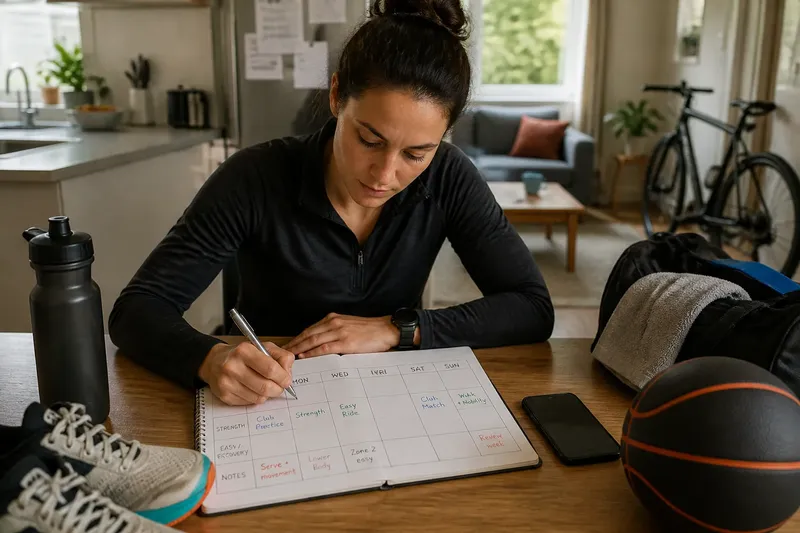
How do you plan training sessions when work, travel and family commitments keep shifting? Start with the week you can see, not an ideal routine: put the fixed obligations on a calendar, then decide what each available window can realistically hold.
Choose a session aim before choosing a time
A calendar slot is easier to use when you know what the session is for. Give each planned session one plain aim, such as practising football passing, building an easy running habit or doing a short strength routine with resistance bands.
Keep the aim specific enough to guide the activity, but not so elaborate that planning becomes a separate task. “Practise passing against a wall” is clearer than “get fitter”; “an easy walk around the park” is clearer than “do cardio”.
Write the aim beside the session, so you can tell at a glance whether the slot and location suit it.
Build the plan from fixed commitments and usable windows
Open a paper diary, wall planner or phone calendar and enter the commitments that cannot readily move: work shifts, classes, appointments and family arrangements. Then look for windows that include the practical details, not just the apparent free time.
A swimming session may need a journey to the pool and time to change. A bodyweight routine at home may need little preparation. A run may require a safe route and suitable daylight. Note the location and any necessary travel or preparation alongside the session.
- If a window ends before a fixed appointment and the venue is nearby, choose an activity that fits the available time; if the journey or changing time crowds out the session, use a nearer option or choose another window.
- If a club practice has a set start time, keep that appointment fixed; if the session conflicts with a non-movable commitment, contact the organiser or select another suitable activity.
- If a planned session needs equipment you will not have with you, move it to a window when the equipment is available; otherwise choose an activity that uses what you have.
- If a route or venue is unavailable at the planned time, select a suitable alternative location; if none is practical, move the session to another usable window.
- If the calendar shows no workable window for the planned activity, reduce the plan to an activity that fits an actual opening; if there is no suitable opening, do not pretend the session is scheduled.
- If a window is repeatedly taken by the same commitment, stop treating it as available and choose a different recurring opportunity; if the commitment is temporary, mark the window to review later.
Make each session easy to start
Put the next action in the calendar or a short note. For a home strength session, that might mean leaving a clear space and setting out a resistance band. For a pool visit, it could mean packing a swim bag before the day begins.
Keep the plan readable. A note such as “Thursday, living room, band routine; aim: practise controlled rows” is more useful than a crowded entry full of vague reminders.
Set out the first item you need before the session, so starting does not depend on remembering several small tasks.
Work through a week with real constraints
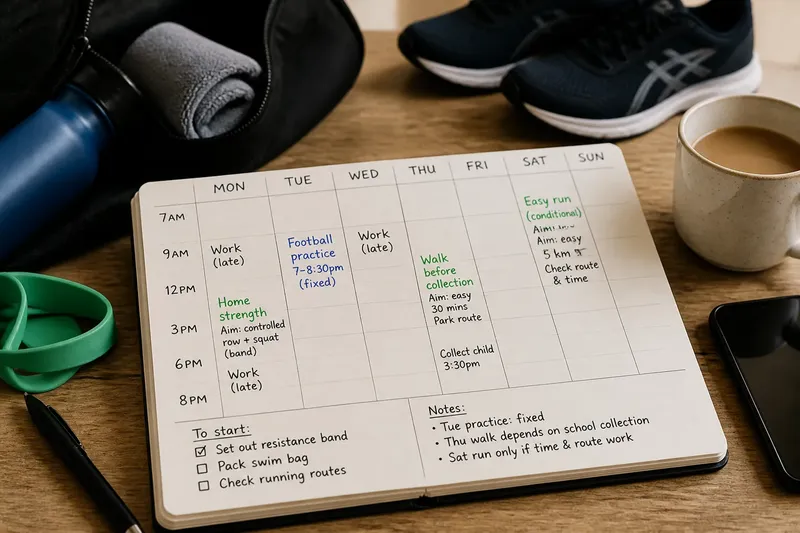
Say you work late on Monday and Wednesday, have a football practice on Tuesday evening, and need to collect a child from school on Thursday. Imagine your available options are a short home session on Monday lunchtime, a neighbourhood walk before Thursday collection, and a Saturday morning slot. These are invented planning details, not a record of a real person.
First, enter the late shifts, Tuesday practice and Thursday collection in the calendar. Keep football fixed because it depends on the team’s shared time. Next, assign the Monday lunchtime window to a short resistance-band routine at home, provided the break is long enough to start and finish without rushing back to work. Put the specific aim beside it: practise a controlled row and squat pattern.
Then check the Thursday journey. If the park is close to the school and the available time allows a walk without risking a late collection, schedule that walk and note the route. If it does not, leave Thursday clear rather than squeezing in a session that conflicts with collection. Finally, use Saturday for an easy run only if the route and other commitments fit; otherwise, treat that opening as unassigned, not as a missed appointment.
The resulting plan has one fixed team session, one home session and one conditional outdoor option. Its trade-off is clear: Thursday activity depends on the collection journey, while Saturday remains available only if the week permits it.
What should you do when the plan does not fit?
Should every session have a back-up time?
Only if another window is genuinely usable. Name the alternative in the calendar when it fits the same activity and practical needs; if it does not, choose a different activity or leave the session unscheduled.
What belongs in a training calendar?
Record the time, activity, aim and location, plus travel or preparation details when they affect whether you can start on time. Mark team sessions and other fixed commitments clearly so you do not mistake them for flexible openings.
How do I plan around a club practice?
Enter the practice as a fixed appointment, then plan other activity in the remaining usable windows. If the practice time clashes with a commitment you cannot change, ask the club about alternatives or choose a different activity that week.
What if the week changes after I plan it?
Update the calendar when a commitment changes, then check which sessions still have a suitable time, place and starting conditions. Move only the activities that remain practical; do not carry a session forward automatically if its new slot does not work.
Keep the personal training plan useful and readable
A personal training plan is not a promise that every opening will stay free. It is a way to connect an activity’s aim with a real time and place, while making conflicts visible before they become last-minute decisions.
To plan training sessions for the coming week, enter fixed commitments, match each activity to a workable window, and record what you need to begin. If a slot fails the practical checks, change the activity or leave it open; a clear decision is more useful than a crowded calendar.