Paper Log or Phone Notes? Pick a Training Record You Will Keep
Choose a paper log or phone notes for training, compare their everyday strengths and make a simple record that fits the moments you can reliably write.

Which training record will you actually use after a session: a paper log in your kit bag or notes on your phone? Choosing between a paper log and phone notes is less about finding the perfect system than matching the format to the moment you can reliably record what happened.
A useful record can be brief. It might capture the session, how demanding it felt, and one detail you want to remember before next time. The right format makes those notes easy to enter, easy to understand later and simple to continue through an ordinary week.
Match the record to your post-session routine
Think about what happens in the minutes after training. Perhaps you sit on the changing-room bench, walk to the bus stop, or get home and unpack your kit. Your likely recording moment matters more than the fact that a notebook looks tidy or a phone offers clever features.
A paper log suits someone who already carries a notebook and likes writing by hand. It is visible, does not ask you to open an app, and can make a quick entry feel like part of putting away your kit. A phone note suits someone who nearly always has their phone nearby and prefers typing or speaking a short entry.
Neither format is automatically more disciplined. A notebook buried under spare clothes may be harder to use than a note pinned on your phone. A phone kept in a locker or left untouched during practice may be less convenient than a pocket-sized pad.
Choose the place where writing can happen without disrupting your session or your journey home.
Paper logs make patterns visible on the page
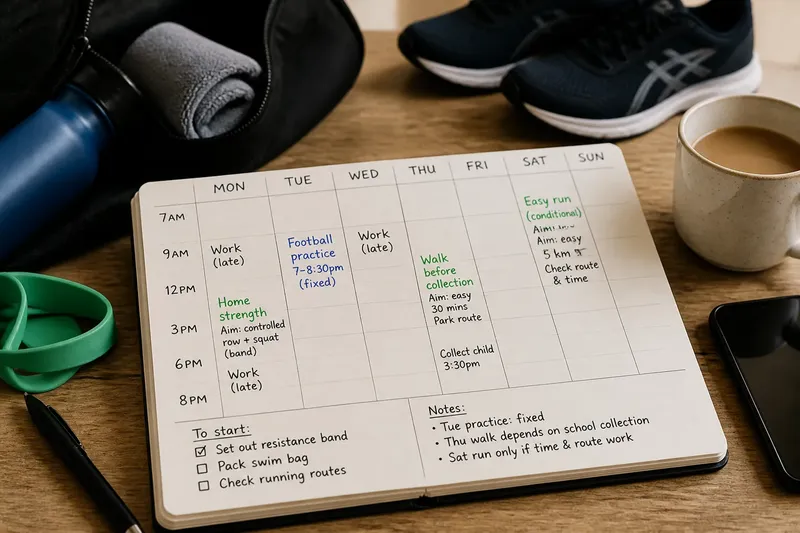
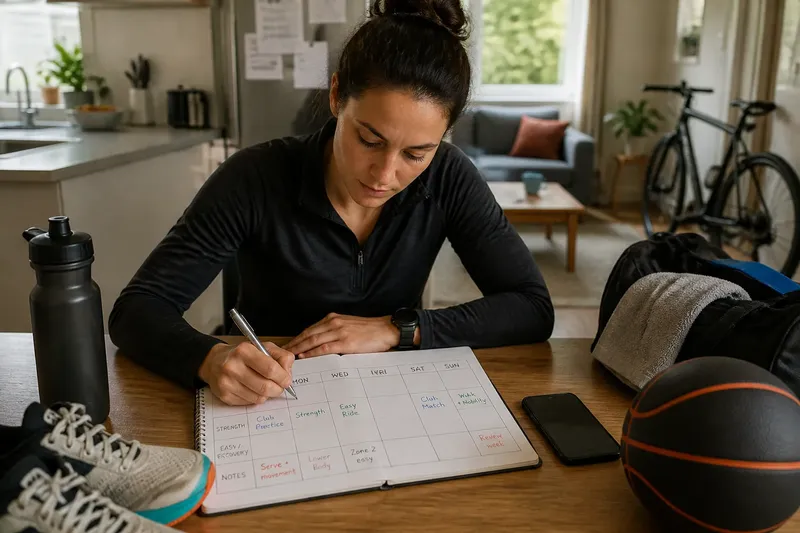
Paper is useful when you want to see several entries together without scrolling. A notebook lets you compare the shape of recent training at a glance: a club practice, a steady run, a rest day, then another session. You can circle a note, add an arrow or leave room beside an entry for a later observation.
Its limits are practical. A notebook can get damp, go missing or be forgotten on the kitchen table. Writing can also feel slow if you are tired, cold or trying to catch a train. If you choose paper, keep the layout modest and the notebook somewhere linked to your routine, such as beside your trainers or in the kit bag.
Leave a little blank space rather than designing a page that requires a long account. A record that asks for every drill, split and feeling can turn a quick habit into a chore.
Phone notes make quick capture flexible
Phone notes are handy if you want to enter a few words immediately, add a voice note while walking, or search for a term later. You can keep one running note or create separate entries with dates. A simple notes app is often enough; a training platform is not necessary unless its extra features solve a real problem for you.
The phone can also invite distractions. A message, notification or tempting app may pull you away before the entry is saved. Typing on a small screen can be awkward with wet hands, and a note without a date can become hard to place in the flow of your training.
Set up a clear title or date pattern, then keep the note accessible. If you use voice input, check that names and exercise terms have been captured sensibly; speech recognition can turn familiar training language into something puzzling later.
Make the first screen of your system easy to reach, not impressive to look at.
Keep the same few details in either format
Paper and phone notes work best when they answer similar questions. Start with enough information to make an entry useful, but not so much that you avoid recording it.
- Session: name the activity or practice, such as club football, a swim or strength work.
- Effort: describe how demanding it felt in ordinary words, such as easy, steady or hard.
- Notable detail: record something concrete, such as a drill that felt unfamiliar or a route that was busy.
- Next-session cue: add one reminder if it will help, such as bringing a water bottle or asking the coach about a movement.
You do not need to fill every line after every session. If nothing stands out, a short entry is still a record. Keep notes about effort descriptive rather than treating them as a score that must rise or fall. The purpose is to help you recognise how your own sessions feel and what context might matter later.
Give a week a simple recording rhythm
A weekly rhythm can help a new record settle into everyday life without making training itself more complicated. Before the week starts, put the notebook where you collect your kit, or open a pinned phone note with a date heading. Do not spend the planning moment building a complicated template.
After each session, make a short entry when you are already pausing: while changing, once you are seated on the bus, or after you have unpacked at home. Choose one moment that fits your circumstances. If writing straight after training is impractical, use a reminder at a time you can usually manage.
Midway through the week, glance over what you have written. Look for useful context, not a verdict on whether the week is good or bad. You might notice that two different sessions felt demanding, or that a particular practice included a drill you want to ask about. Let the observation guide a sensible question or conversation rather than an automatic change to your routine.
At the end of the week, add a brief note only if it helps you carry information forward. For example, you might record that the route was muddy or that you would like to discuss a technique with your coach. If the week was busy and you missed an entry, leave the gap. Do not invent details to make the page look complete.
Keep the routine light enough to survive a week that does not go to plan.
Switch formats without losing useful context
It is fine to change formats if your circumstances change. A notebook may suit a season when you leave your phone in a locker; phone notes may be easier when you travel between work and a club. You can also use one as the main record and the other for an occasional detail, but avoid scattering important notes across places you will not remember to check.
Say you keep a paper log beside your running shoes, then begin commuting straight from work to evening practice. You could move the main record to a dated phone note and copy across only the few recent details you still need, such as a recurring route concern or a question for your coach. The expected observable result is that new entries are easier to make on those evenings while older context remains available in one place.
When moving notes, do not feel obliged to transfer every old entry. Bring forward information that may help you make sense of current sessions; leave the rest archived in its original form. A simple heading such as “Earlier notebook notes” can make the boundary clear.
Which training record fits your habit?
Is a paper training log better than phone notes?
Neither is better for everyone. Paper can make nearby entries easy to scan, while phone notes can make immediate capture convenient. Choose the one you can reach at the moment you are most likely to write.
What should I write after a training session?
Start with the activity, a plain-language description of effort and one detail worth remembering. Add a next-session cue only when it gives you something useful to act on.
Should I record every exercise or drill?
Only record that level of detail if it helps answer a question you genuinely have. For many recreational routines, a concise account of the session and one notable point is easier to maintain and review.
What if I forget to make an entry?
Leave the gap or add a brief note saying you missed it, rather than guessing from memory. Resume with the next session; a record is for useful context, not a perfect run of entries.
Choose the smallest record you will reopen
Try your chosen format through a normal week, including the session that makes recording least convenient. If the notebook stays in the bag or the phone note becomes difficult to find, adjust where you keep it or shorten what you ask yourself to write. You need not change the whole system at once.
A paper log or phone notes can both become a dependable training record when the entry is quick to make and clear to read later. Keep the format close to your real routine, and let its job be modest: preserve the details that help you understand your own training and return to your next session with one useful thought.